
How long to learn Quran reading is a common question for parents and beginners starting their Quran learning journey. The time depends on the learner’s starting level, regular practice, teacher guidance, and support at home. Some beginners learn the foundations of Noorani Qaida within several months, while others need more time to develop confident Quran reading. This guide explains realistic learning stages, common challenges, and practical ways to improve Quran reading without unnecessary pressure.
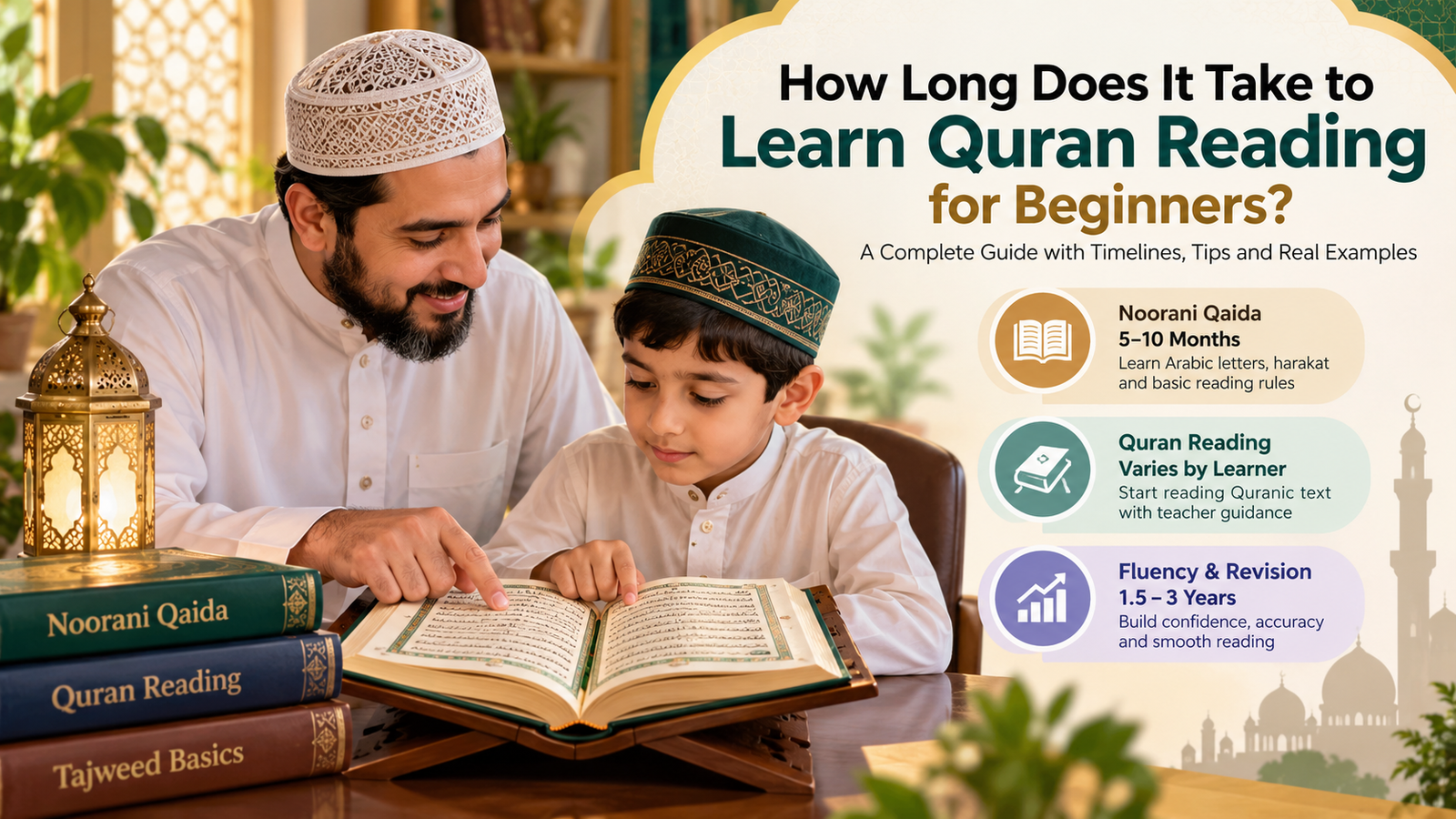
How Long to Learn Quran Reading? A Practical Timeline
There is no fixed number of months that applies to every student. In teaching experience, the time needed can vary according to letter recognition, pronunciation, attention, attendance, and home revision.
The following time ranges are practical teaching observations, not guaranteed results or universal educational standards.
Faster Foundation Progress
Some learners become comfortable with the main Noorani Qaida foundations within this period when they attend regularly and practise at home.
A Common Teaching Observation
Many beginners need this kind of timeframe to develop letter recognition, basic vowel reading, joining letters, and foundational reading skills.
More Time for the Foundation
Some learners need a longer period to strengthen recognition, pronunciation, and confidence. Additional time is a normal part of individual learning.
How Long Does It Take to Learn Quran Reading After Qaida?
After completing Noorani Qaida, students begin reading the Quran directly. This stage involves more than recognising Arabic letters. Learners gradually improve fluency, pronunciation, rhythm, and confidence while reading connected Quranic words and verses.
Based on teaching observations, completing the first reading of the Quran and developing stronger fluency may take around 2–3 years in some cases. Some students progress faster, while others require more time and revision.
First Quran Reading and Revision Are Different Stages
Finishing the Quran once does not necessarily mean that a learner has reached fluent reading. A teacher may assess whether the student can read independently, recognise mistakes, and maintain accuracy.
If reading is reasonably fluent, the student may continue practising at home. If the learner still hesitates frequently, structured revision with the teacher and parent can help strengthen the foundation.
What Affects How Long It Takes to Learn Quran Reading?
The time required to learn Quran reading depends on several practical factors. Understanding these factors helps parents set realistic expectations and support steady improvement.
1. Starting Level and Arabic Letter Recognition
Some children can recognise individual Arabic letters but find it difficult to combine them into words. Others may confuse letters with similar shapes or sounds. A teacher first identifies the learner’s actual level rather than assuming every beginner needs the same starting point.
2. Understanding Harakat
Zabar, zer, and pesh are essential early reading foundations. Learners need repeated practice to recognise how these signs affect pronunciation and how sounds change when letters are joined.
3. Correct Pronunciation and Makharij
Correct pronunciation develops gradually. A teacher listens carefully, identifies the source of an error, and helps the student practise the correct sound. Tajweed refinement continues during Quran reading; it is not limited to one lesson or one stage.
4. Regular Quran Class Attendance
Consistent lessons help students retain what they have learned. Frequent gaps between classes may make it harder to remember previous material, especially during the early Qaida stage.
5. Daily Quran Reading Practice at Home
A short, focused revision session can make a meaningful difference. Around 15 minutes of daily practice is a useful starting point, while 20–30 minutes may be helpful when the learner can maintain attention comfortably.
6. Parent Support and Encouragement
Parents can support progress by helping children attend on time, arranging a quiet learning space, listening to revision, and encouraging effort. Calm correction is generally more helpful than pressure or comparison with other children.
How to Learn Quran Reading Step by Step
A structured approach makes it easier to understand what the learner is working toward at each stage. The teacher should adjust the pace according to the student’s actual reading ability.
Learn and Recognise Arabic Letters
Begin with letter recognition, shapes, and sounds. The teacher checks whether the learner can identify letters consistently rather than only memorising them in sequence.
Practise Harakat and Letter Joining
Learn zabar, zer, pesh, and basic combinations. Practise reading connected letters slowly and accurately before increasing speed.
Build Foundational Quran Reading Skills
Develop familiarity with basic madd and other essential Qaida lessons. The teacher checks whether the learner can apply these foundations in practice.
Start Quran Nazra
Once the learner can recognise letters, apply basic harakat, join letters, and use foundational reading rules, the teacher can assess readiness for Quran reading.
Improve Quran Reading Fluency
Continue reading with teacher feedback. Correct recurring mistakes, practise difficult words, and gradually develop smoother reading while maintaining accuracy.
How Much Daily Practice Helps You Learn Quran Reading?
A consistent routine is generally more practical than occasional long sessions. The goal is focused revision that the learner can maintain without becoming overwhelmed.
| Practice Routine | Suggested Use | Purpose |
|---|---|---|
| 15 minutes daily | Short home revision | Reinforce the current lesson |
| 20–30 minutes | When the learner can focus comfortably | Practise reading and review mistakes |
| Monday–Friday classes | Regular guided learning | Maintain continuity and teacher feedback |
| Weekend revision | Optional review with parent or teacher | Strengthen previously learned material |
How One-to-One Quran Classes Help Beginners Learn Reading
In a one-to-one class, the teacher can observe the learner’s reading directly and adjust the lesson according to their current ability. This is useful when a student recognises letters but struggles to join them, confuses similar sounds, or needs repeated pronunciation practice.
A focused 30-minute class can provide time for lesson revision, new material, reading practice, and correction. A shorter focused session may also be suitable in some circumstances. The teacher can use the final few minutes for a dua, hadith, prayer method, or basic Islamic Studies as supplementary learning.
Learn more about our Online Quran Reading Classes for Beginners.
How Teachers Correct Quran Reading Mistakes
Effective correction is not only about telling a student that a word is wrong. The teacher should help the learner understand what needs to change.
- Allow the learner to try again and notice the mistake independently.
- If the learner cannot correct it, demonstrate the correct reading.
- Explain the reason for the correction in simple language.
- Practise the difficult letter, sound, or word again.
- Review the same point in a later lesson to check retention.
This approach supports accuracy while helping students become more confident and independent readers.
How Long Does It Take Adults to Learn Quran Reading?
Adults can begin or improve Quran reading through structured lessons and regular practice. Their learning needs may differ from those of children because of prior Arabic exposure, available practice time, and personal learning goals.
In my teaching experience, the adult students I have taught generally already knew Noorani Qaida. Some improved their reading fluency over approximately 1–1.5 years, depending on consistency and starting ability. This is an observation from those students, not a guaranteed timeline for adults starting from zero.
Adults who are completely new to Arabic letters should begin with a proper foundation and progress at a comfortable pace.
A Real Teaching Example: A Beginner’s Quran Reading Journey
One six-year-old girl in Pakistan began learning from zero and completed her Quran reading journey with good fluency in approximately 1.5 years. Her parents supported her learning and helped maintain consistency.
This is one individual teaching example, not a standard timeframe for every child. It illustrates how a learner’s starting point, regular lessons, home support, and individual progress can influence the learning journey.
Signs a Student Is Ready to Start Quran Nazra
A teacher may assess whether the learner can:
- Recognise Arabic letters reliably.
- Read basic harakat with reasonable accuracy.
- Join letters and read simple combinations.
- Apply foundational madd lessons.
- Attempt reading without relying only on memorised page patterns.
- Receive correction and try the reading again.
These are practical readiness indicators, not a formal examination or a requirement that every learner must meet perfectly before beginning Quran reading.
External Quran Reading and Learning Resources
Alongside teacher-guided lessons, learners can use reliable Quran resources for reading, listening, and reviewing Arabic words.
- Quran.com – Read and listen to the Quran provides Quran text, recitations, translations, and tools for following the text while listening.
- Quranic Arabic Corpus offers word-by-word Arabic grammar, morphology, and linguistic information for Quranic text. It is a reference resource, not a replacement for a qualified Quran teacher.
Frequently Asked Questions About How Long to Learn Quran Reading
How long does it take to learn Quran reading from zero?
The time varies. In teaching observations, Noorani Qaida may take around 5–6 months for some quicker learners, 7–8 months for many others, and 9–10 months or longer for learners who need more practice. Quran reading and revision can take additional time.
Can a child learn Quran reading in one year?
Some children may make substantial progress within a year, but completing the foundation and developing confident reading are different goals. Progress depends on starting level, attendance, practice, and individual learning needs.
How many minutes should a beginner practise Quran reading daily?
Around 15 minutes of focused daily revision is a practical starting point. Some learners benefit from 20–30 minutes when they can remain attentive and comfortable.
Does completing Noorani Qaida mean the student can read fluently?
Not necessarily. Qaida builds the foundation. Fluency, pronunciation, and accurate Quran reading continue to develop through guided reading and revision.
Can adults improve Quran reading after years without practice?
Yes. Adults can refresh their foundations, correct pronunciation, and improve fluency through regular lessons and manageable home practice.
Are one-to-one online Quran classes suitable for beginners?
One-to-one lessons allow the teacher to focus on the learner’s reading level, listen to pronunciation, correct mistakes, and adjust the pace of instruction.
Related Quran Learning Resources
Start Your Quran Reading Journey with Guidance
Whether you are a parent looking for Quran lessons for your child or an adult wishing to improve your own reading, a suitable starting level and consistent guidance can help you move forward with confidence.
Explore Quran Reading Classes →